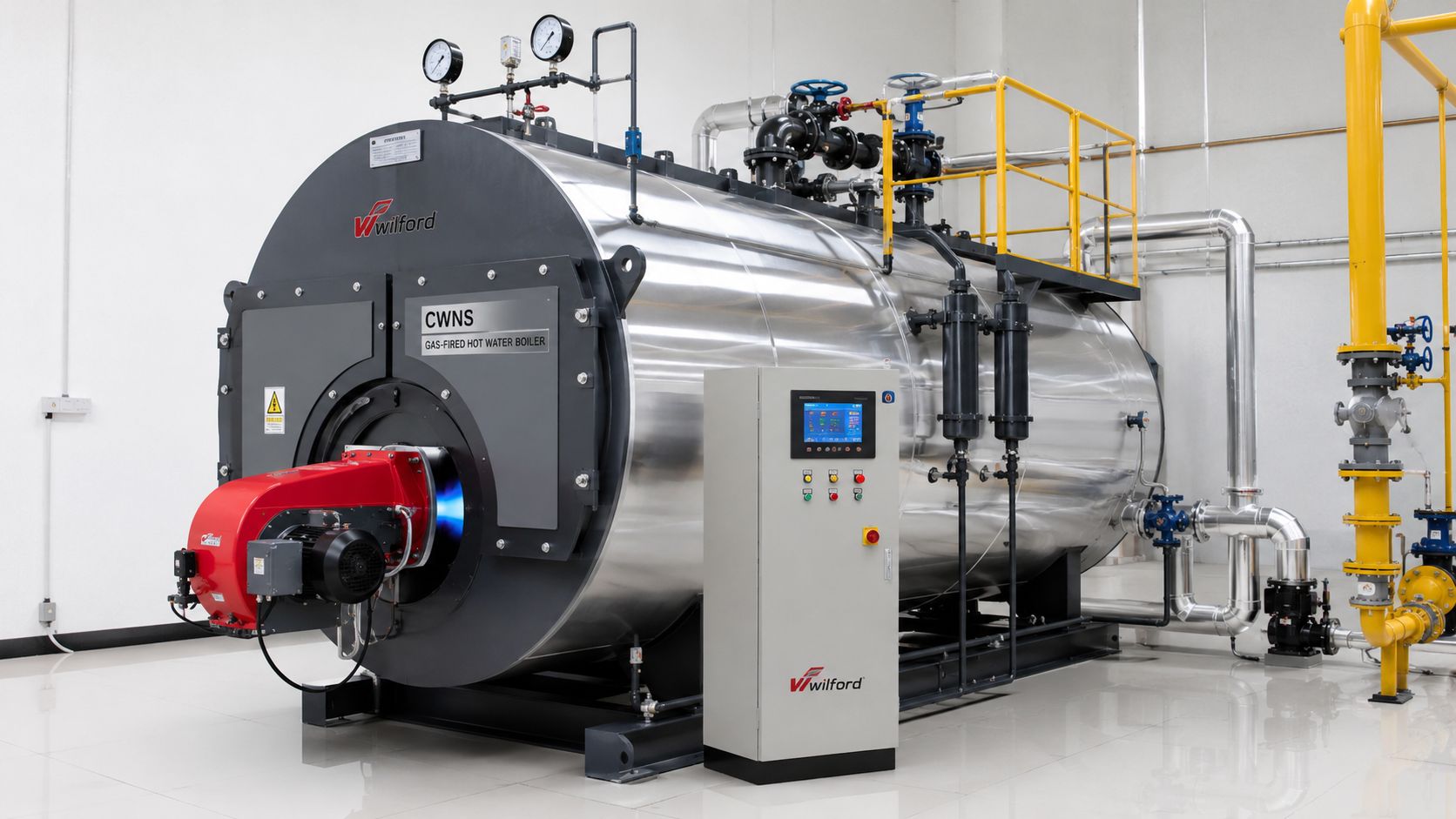
Gas-fired Volumetric Hot Water Boiler CWNS Series
Horizontal internal-combustion three-pass wet-back gas-fired hot water boiler with thermal efficiency of 93%-96%. Corrugated furnace chamber plus threaded flue tubes deliver highly efficient heat exchange, suitable for central heating and hot water supply in commercial complexes, hotels, hospitals, and more.
产品特性
产品描述
Gas-fired Volumetric Hot Water Boiler CWNS Series
The CWNS series is a horizontal internal-combustion three-pass wet-back gas-fired hot water boiler, adopting a high-efficiency heat exchange structure with large furnace chamber + corrugated furnace chamber + threaded flue tubes, achieving a thermal efficiency of 93%-96%. It is suitable for central heating and hot water supply in commercial complexes, hotels, hospitals, industrial parks, and other facilities.
Core Features
- Wet-back structure: fully water-cooled rear smoke box, service life exceeding 15 years
- Corrugated furnace chamber: increases radiant heating area by approximately 30%
- Threaded flue tubes: convective heat transfer coefficient improved by 40%
- Large combustion chamber: NOx emissions <80mg/m³
Specifications
| Model | Heat Output | Heating Area | Natural Gas Consumption | Outlet Water Temperature | Thermal Efficiency |
|---|---|---|---|---|---|
| CWNS-0.35 | 0.35MW | 3000-4000㎡ | ≈38Nm³/h | 85℃ | ≥93% |
| CWNS-0.7 | 0.7MW | 6000-8000㎡ | ≈76Nm³/h | 85℃ | ≥94% |
| CWNS-1.4 | 1.4MW | 12000-16000㎡ | ≈152Nm³/h | 85℃ | ≥95% |
| CWNS-2.1 | 2.1MW | 18000-24000㎡ | ≈228Nm³/h | 85℃ | ≥95% |
| CWNS-2.8 | 2.8MW | 24000-32000㎡ | ≈304Nm³/h | 85℃ | ≥96% |
Northeast China application: Multiple commercial complexes in Harbin and Changchun adopt the CWNS series as the primary heat source for heating. Combined with a climate compensator, gas savings of approximately 15% can be achieved compared with constant-temperature operation.
服务热线
18686730186