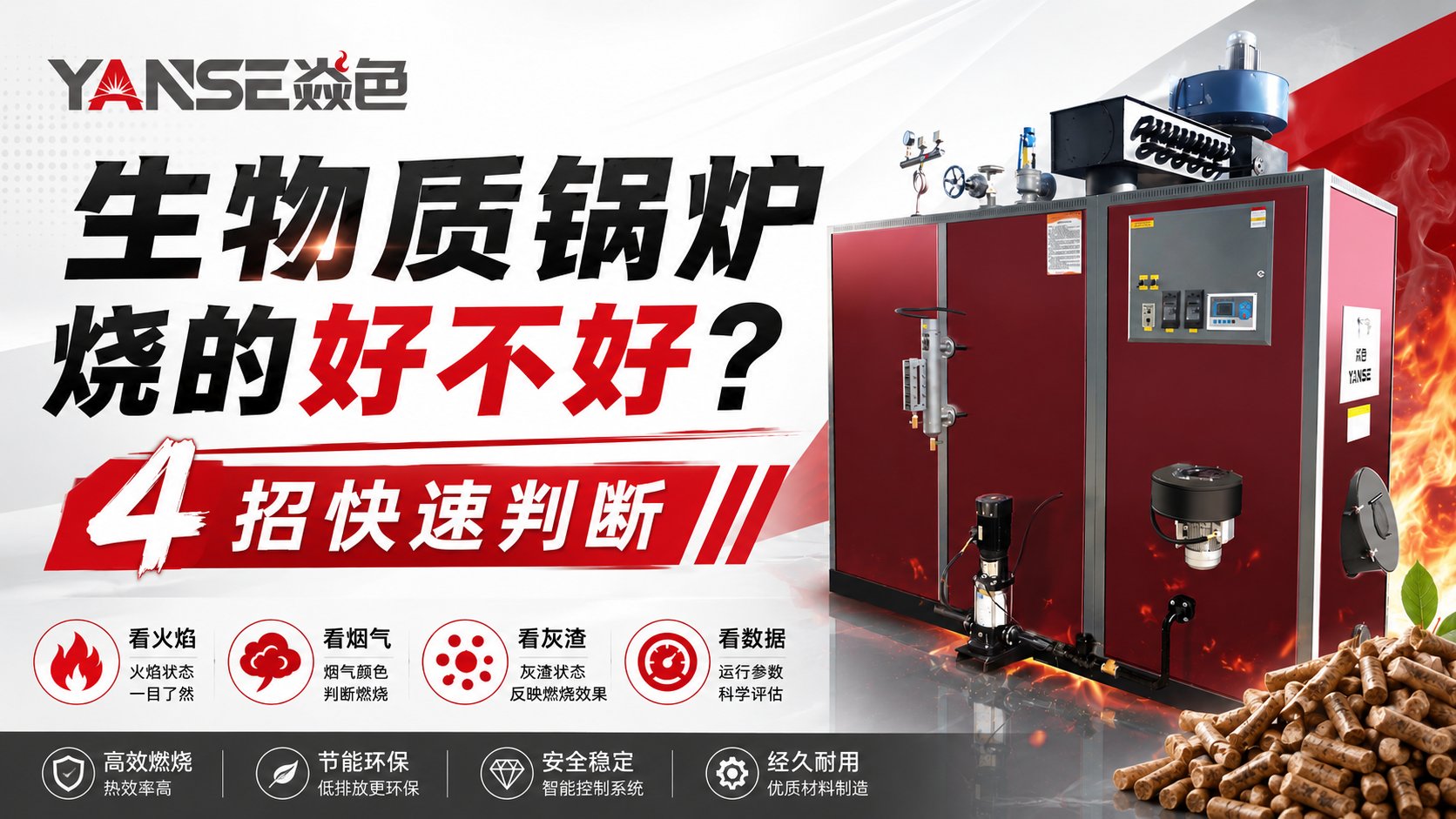
How to Judge the Combustion Status of a Biomass Boiler? Four Quick Methods for Identification
2026-07-02公司新闻
Publisher: Heilongjiang Jingyu Thermal Energy Equipment Manufacturing Co., Ltd. · Updated: 2026-07-02
In the biomass energy industry, the combustion status of a boiler is directly related to energy utilization efficiency, operating costs, and environmental emissions. However, many users tend to judge whether a boiler is "burning well" based on experience in daily operations, lacking a systematic and intuitive method of assessment. By mastering the following four observation dimensions, operators can accurately evaluate the boiler's combustion status in a short time without the need for complex instruments.
1. Observe Flame Color
The flame is the most direct "barometer" of combustion status. During normal combustion, the flame should appear orange-yellow, bright and forceful, with the flame root closely attached to the grate, and the overall shape full and powerful—this indicates that the fuel-to-air ratio is reasonable, combustion is sufficient, and the furnace temperature is stable. If the flame is dark red, soft and floating, and flickers like a "candle in the wind," it usually means the furnace is oxygen-deficient, and combustible gases are drawn away before being fully burned. In this case, the air supply should be increased, and the induced draft fan speed and damper opening should be checked. Another scenario: if the flame is glaring white, short and rapid, like a compressed jet, it indicates excessive air volume—the extra cold air not only shortens the flame but also carries a large amount of heat out through the chimney, causing thermal efficiency to plummet. Additionally, if the flame is intermittent and erratic in size, it is often related to uneven feeding by the screw feeder. Check whether the feed hopper is bridging, whether the feed motor speed is fluctuating, and whether the fuel moisture content is consistent.
2. Observe Flue Gas Color
Chimney emissions are the most intuitive basis for judging combustion completeness and are also a key focus of environmental inspections. The optimal state is no visible black smoke at the chimney outlet, or only faint white water vapor drifting out—at this point, volatile matter is fully burned, and particulate emissions remain at a low level. If the chimney continuously emits yellow-brown or black smoke plumes, it indicates severely insufficient air supply, or excessive single-feed volume causing accumulation in the furnace. The fuel undergoes pyrolysis under oxygen-deficient conditions, producing tar and carbon black, which are drawn away by the induced draft fan before being fully combusted. This situation not only wastes fuel and reduces thermal efficiency but also causes tar to condense on the heat exchange tube walls, accelerating scaling and blockage, and may even corrode the flue pipes and induced draft fan impeller in severe cases. Operators should adjust the air-coal ratio and feeding frequency in real time based on smoke blackness, and reduce the feeding speed temporarily if necessary, resuming normal operation after the furnace temperature recovers.
3. Check Ash Condition
Ash is the final product of the combustion process, yet it best reflects the thoroughness of combustion. Ash from complete combustion should appear as a grayish-white fine powder, with a fine and loose texture and no visible black carbon particles or hard lumps. Take a small amount of ash from the ash discharge opening beneath the grate and spread it on the palm for observation: if the ash is black, contains obvious caked lumps, or even includes unburned yellow-brown biomass particles, combustion is incomplete. There are three common causes: first, insufficient air supply, causing incomplete carbonization of fuel on the grate; second, excessive feeding speed, leaving insufficient residence time in the high-temperature zone; third, excessive fuel moisture content (exceeding 15%), where water evaporation consumes a large amount of heat, lowering the furnace temperature and resulting in incomplete combustion reactions. It is recommended to establish an ash inspection log, take photos for documentation during each cleaning shift, and infer the合理性 of operating parameters from the ash residue condition.
4. Monitor Equipment Operating Parameters
Beyond the three sensory judgments mentioned above, the stability of operating parameters is also a key indicator for determining whether combustion status is normal. During normal combustion, the furnace temperature should be maintained between 850 and 950 degrees Celsius, the induced draft negative pressure should be in the range of approximately -150Pa to -250Pa, and the two curves should trend smoothly with fluctuations within a reasonable range. If the temperature curve fluctuates sharply or frequently, or fails to rise, it indicates insufficient heat storage in the furnace—this may be due to low fuel calorific value, excessive moisture content, or excessive air supply. If the negative pressure gauge reading fluctuates violently or remains persistently low (close to zero pressure), there may be serious ash accumulation in the flue, insufficient induced draft fan output, or even a risk of backfire. Special attention should be paid: when the system frequently triggers alerts such as "feeding fault," "over-temperature alarm," or "flameout protection," it indicates that the combustion condition has severely deviated from design values, and the unit must be shut down immediately for troubleshooting—check whether the grate is coked and blocked, whether the thermocouple is malfunctioning due to tar encasement, and whether there are abnormalities in the feeding and air supply linkage logic. It is recommended to export operating data weekly to form trend charts. After accumulating 2 to 3 months of data, you can clearly see the equipment's performance curves under different fuel batches and seasonal conditions, providing a scientific basis for routine maintenance and spare parts replacement.
The four methods above corroborate each other, progressing from simple to in-depth, helping operators quickly locate issues in the combustion process without relying on expensive testing instruments. In practical application, the first step is always to clearly observe the "flame color" and "flue gas color"—these two indicators can tell you in 10 seconds whether the equipment is operating normally or has hidden risks. The second step is to check the ash at the discharge opening to verify the judgment of the first two steps from the results. The third step is to make precise adjustments based on instrument parameters. Combining all three can form a complete and actionable rapid diagnostic system for biomass boiler combustion status. Standardized operating methods and scientific judgment criteria are the foundation for ensuring long-term efficient operation of equipment, and also the core link for enterprises to achieve energy savings, consumption reduction, and green production.